
The Rate Reset: Lenders Split on the Response, but Capital Keeps Moving
Six months ago, lenders told us their biggest problem was each other. Competition was the leading headwind for nearly half of respondents, two-thirds expected the 10-year Treasury to finish 2026 at or below 4.25%, and three-quarters planned to grow allocations. September’s survey shows how quickly that changed.
Slatt Capital’s fourth Lender Sentiment Survey, our largest yet, finds interest rates back at the center of lender concern. The more important finding is who moved and who did not. The market is not retreating in unison; it is splitting by capital source.
Rates: Not a Drift, a Flip
In February, 68% of lenders expected the 10-year to end 2026 at or below 4.25%. In September, 1% do. Seventy-seven percent now expect 4.75% or higher, including 30% above 5%. Interest rates returned as the top headwind for 44% of respondents, up from 10%, while competition fell from 47% to 20%.
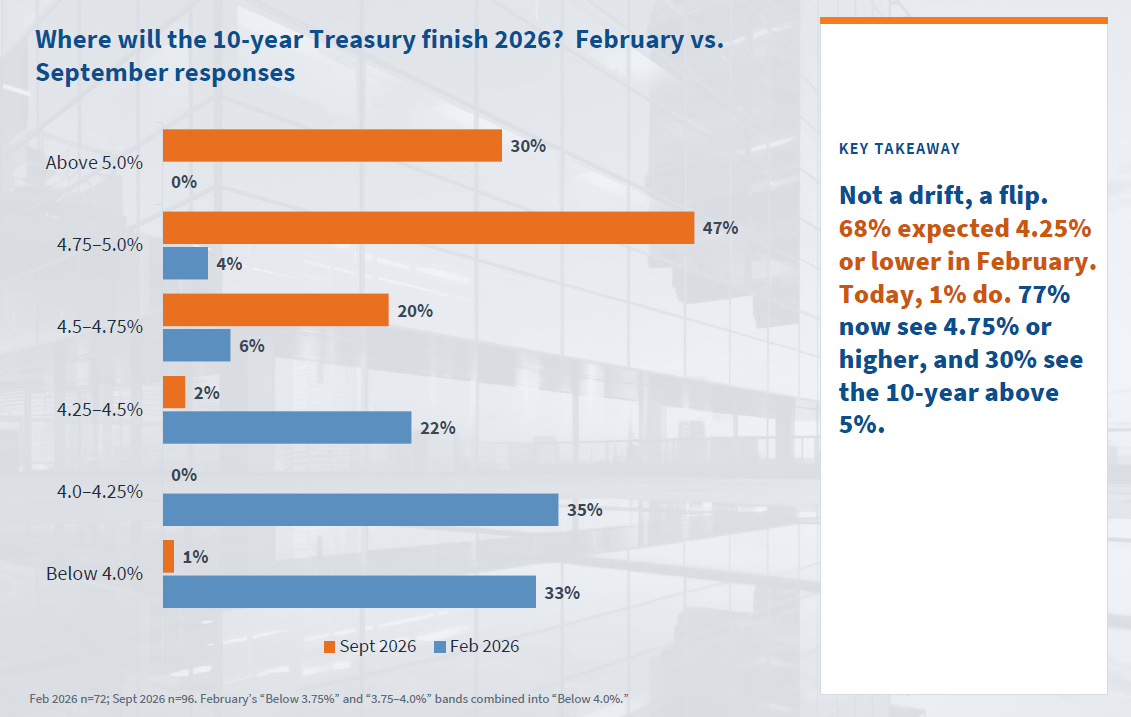
Why it matters: Underwriting built on a sub-4.25% year-end is being rewritten, and borrowers should expect proceeds and pricing to reflect it.
Who Moved: Life Companies and Banks, Not Debt Funds
Among life companies, the share naming rates as their top headwind jumped from 15% to 62%; among banks, from zero to 45%. Debt funds and private lenders barely moved (14%) and instead pointed to market fundamentals (29%) and credit appetite (21%). Banks are the most hawkish, with 42% expecting the 10-year above 5%.
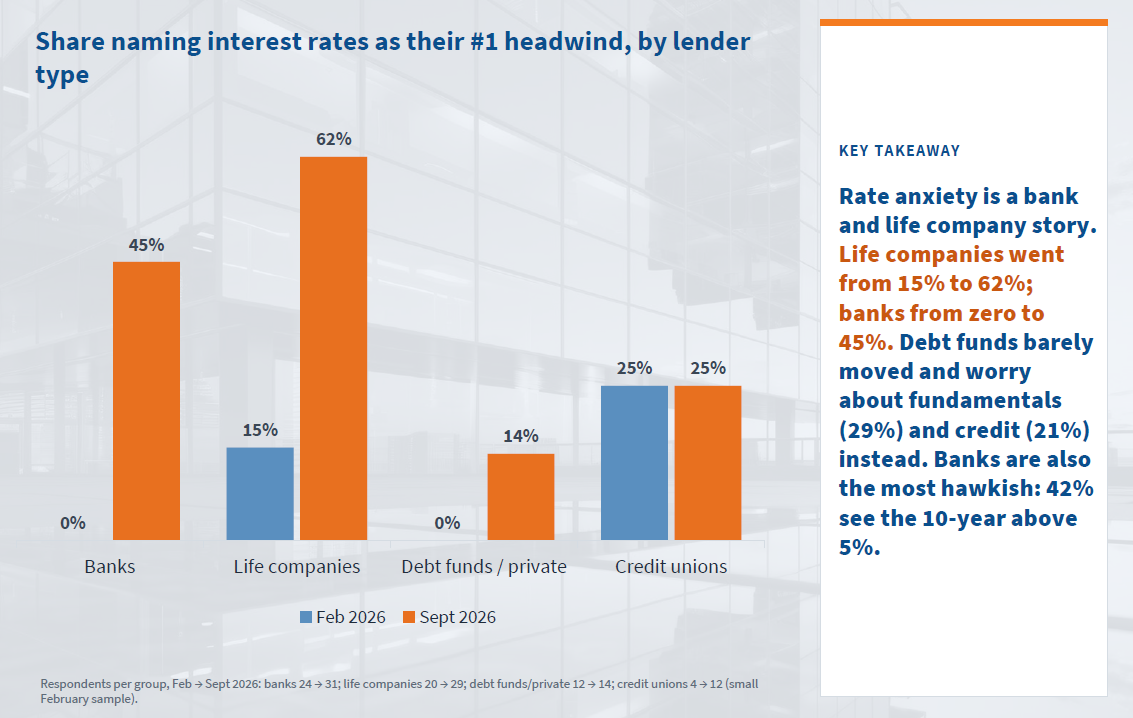
Why it matters: The right capital source now depends as much on the lender’s balance sheet as on the asset.
Allocations: Growth Cools, and the Pullback Is Rate-Linked
Half of respondents still expect allocations to rise, down from 76%. Those expecting growth to remain flat rose to 41%, while 9% expect a decline, the highest in any wave. Life companies remain the most committed (up 66%), followed by banks (52%); debt funds fell from 83% to 43% and credit unions from 50% to 25%. Among lenders expecting the 10-year above 5%, 24% plan to cut allocations, versus 3% of everyone else.
Why it matters: Capital is available, but depends on the lender’s rate view. The lenders most concerned about higher rates also have high allocation expectations, so expect spreads to tighten.
Volume Leadership Swings Back to Private Capital
Debt funds and private lenders (44%) regained the top spot for expected volume growth, overtaking banks and credit unions (39%), who led in February. Tellingly, 52% of banks now expect debt funds to gain the most volume; in February, half of banks picked their own sector.
Why it matters: Transitional and higher-leverage requests will increasingly find their home with debt funds and private credit.
Sector Rotation: Multifamily Narrows, Office Fades, Hospitality Rises
Multifamily remains the most competitive product type at 34%, its lowest reading in four surveys (40%, 50%, 42%, 34%). Industrial (26%) and retail (24%) have closed the gap, and retail’s gain spans banks, life companies and debt funds. Office as the least competitive sector has declined every wave, from 61% to 46%, while hospitality has climbed from 17% to 32%.
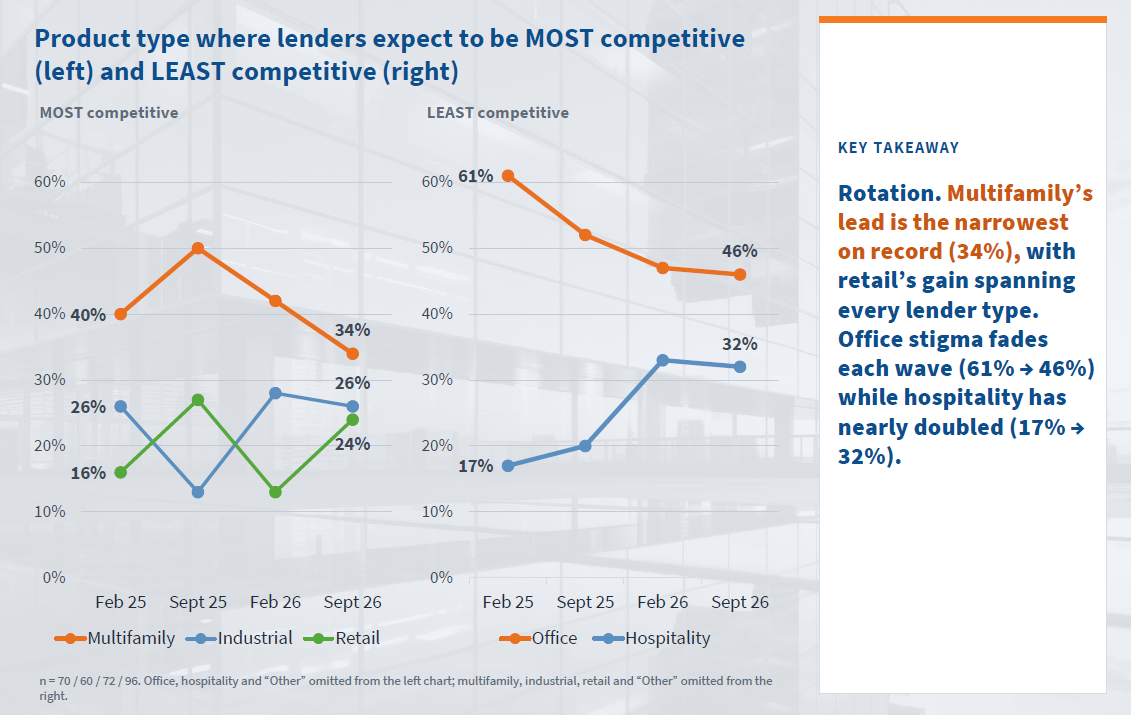
Why it matters: Borrowers in retail and industrial should see more competitive options; hospitality sponsors should expect fewer competitive options.
Bridge: Banks Are the Swing Factor
A combined 54% expect bridge volume to rise at least 10%, up from 46% in February and 37% last September. Banks drove the move: in February, 42% of banks were unsure and 17% expected growth; now 48% expect growth and 19% are unsure. Two new questions point the same way: 71% will hold target loan size and two-thirds plan no new products, yet bridge is the most common planned addition (15%), led by banks and credit unions.
Why it matters: Lenders are defending existing footprints while reaching selectively into transitional lending.
Summary and Actionable Takeaways
This is not a market in retreat. It is a market sorting itself. Rate pressure returned, but it landed unevenly, and the lenders most exposed to it are also the ones still planning to grow. The capital source now matters as much as the deal.
For lenders: compete on certainty, structure and speed rather than price, and know which competitors are still leaning in.
For borrowers: match the request to the capital source. Bank and life company appetite is intact but rate-sensitive; private capital is where volume growth is expected.
For investors: watch the three-sector field in multifamily, industrial and retail, and the fading office stigma.
For more information about Slatt Capital’s Lender Sentiment Survey or to be included in the next survey group or communication to participate, please click here.
Click to download presentation here.